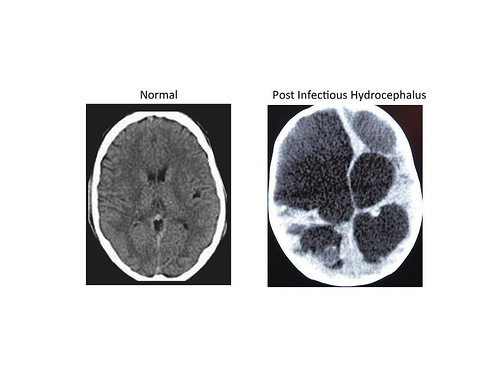
<p>Hydrocephalus is a serious condition that occurs when cerebral spinal fluid, or CSF, accumulates around the brain and does not drain as normal. This accumulation causes additional pressure on the brain, which can result in multiple symptoms. Over time, it can result in serious brain damage or death.</p>
<h3><strong>Who Gets Hydrocephalus?</strong></h3>
<p>Hydrocephalus is very common in children and the elderly, but it can affect a person of any age. It is more likely to affect someone who has had a head injury, brain tumor or other neurological condition. It may also be congenital and affect an unborn child.</p>
<p>The symptoms of hydrocephalus in young children is very different than it is in adults because the bones of a child’s skull or not fully fused. This means that as the cranial cavity fills with fluid, the skill can expand to accommodate it. This also means that children have a higher tolerance for hydrocephalus because they will not suffer pressure damage as quickly, but treatment should still be sought as quickly as possible.</p>
<p>If left untreated for even a small amount of time, hydrocephalus can causes severe developmental delay. The most common sign of hydrocephalus in children thus becomes a sudden enlargement of the head or an abnormally large head upon birth. Other symptoms include seizures, vomiting, irritability, unusual drowsiness or an unusual downward deviation of the eyes, which is also called sunsetting.</p>
<p>When an adult or older child has hydrocephalus the skull remains normal because it is fully fused and unable to expand. Pressure can thus build on the brain very rapidly. Nausea, frequent headache and unusual drowsiness are among the first symptoms. As the pressure begins to affect the optic disk and optic nerve, the person will suffer vision problems such as blurred vision, double vision or sunsetting.</p>
<p>As the pressure builds and begins to cause brain damage, the person will suffer mood and behavior changes, memory loss that can be severe, loss of motor coordination, balance problems and urinary incontinence.</p>
<h3><strong>Correct Diagnosis is Key</strong></h3>
<p>Especially in adults, the common symptoms of hydrocephalus are similar to a variety of other neurological conditions such as Alzheimer’s and Parkinson’s disease. A doctor must take a variety of extra tests to determine the exact cause of the symptoms such as brain scans, spinal taps and cranial pressure monitoring. Due to the broad range of symptoms and the fact that many individuals with hydrocephalus display different symptoms, these tests are very important.</p>
<h3><strong>Treatments</strong></h3>
<p>Every patient has a different tolerance for hydrocephalus, and hydrocephalus can advance at different rates. Communicating hydrocephalus allows some drainage of CSF, so it does not progress as quickly. Hydrocephalus that results from a complete blockage of CSF may progress very rapidly to a damaging or even terminal stage. If any symptoms are showing, it is important to get the correct tests immediately.</p>
<p>Once the nature of the hydrocephalus has been identified, cranial pressure monitoring can help determine its severity and progression. The condition rarely if ever is self-correcting and almost always requires surgery at some point. The doctor may use a shunt inserted into the brain to drain the fluid. Sometimes a neuroendoscope can be used to make a small hole in the ventricle and allow the fluid to drain past the obstruction.</p>
<p>If you know someone who is showing symptoms of hydrocephalus, you should recommend that they see a doctor immediately.</p>
<h5>Featured images:</h5>
<p><span class="license">License: Creative Commons</span></p>
<p><span class="source">image source</span></p>
<p>Erin Guzzetta is a freelance health writer who loves spending time with her children. She contributes to several websites, including Lansing Neurosurgery, a center that treats many neurological disorders.</p>

When Should You Operate On Hydrocephalus?