<h2 style="text-align: justify;"><strong>Firearms</strong></h2>
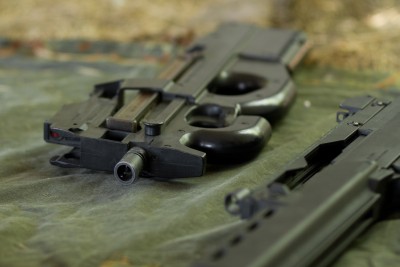
<p style="text-align: justify;">A firearm is a manageable gun, being a barrelled weapon which launches one or more projectiles often defined by the action of an explosive. Firearms may sometimes be referred to as small arms when they are intended primarily for use by military forces and if they can be carried by a single individual.</p>
<h2 style="text-align: justify;"><strong>Ammunition</strong></h2>
<p style="text-align: justify;">Ammunition or ammo is gunpowder and artillery, or generally anything that can be used in combat which includes bombs, missiles, warheads, land mines, naval mines, and anti-personnel mines.</p>
<p style="text-align: justify;"><img class="aligncenter size-full wp-image-6416" alt="What Are The Parts Of Firearms and Ammunition?" src="https://medusamagazine.com/wp-content/uploads/2013/08/14644396_s.jpg" width="400" height="267" /></p>
<p style="text-align: justify;">Ammunition and firearms have three (4) basic components:</p>
<h3 style="text-align: justify;"><strong>1. Explosive Materials</strong></h3>
<p style="text-align: justify;">An explosive material is a reactive substance that contains a great amount of potential energy that can produce an explosion if released suddenly, while usually accompanied by the production of light, heat, sound, and pressure. An explosive charge is a measured quantity of explosive material.</p>
<p style="text-align: justify;">The potential energy stored in an explosive material may be:</p>
<ul style="text-align: justify;">
<li>Chemical energy &#8211; nitroglycerin or grain dust</li>
<li>“Pressurized” gas- a gas cylinder or aerosol can.</li>
<li>Nuclear energy- such as in the case of fissile isotopes uranium-235 and plutonium-239</li>
</ul>
<p style="text-align: justify;">Explosive materials may also be categorized by the speed at which they expand. Materials that detonate (meaning those that explode faster than the speed of sound) are said to be considered as &#8220;high explosives&#8221; while those materials that deflagrate are said to be &#8220;low explosives&#8221;. Meanwhile, explosives may also be categorized by their sensitivity. There are sensitive materials which can be initiated by a relatively small amount of heat or pressure are primary explosives and materials that are relatively insensitive are secondary or tertiary explosives.</p>
<h3 style="text-align: justify;"><strong>2. Gunpowder</strong></h3>
<p style="text-align: justify;">Gunpowder, or since the late 19th century also known as black powder, was the first chemical explosive and the only one known until the mid-1800s which is a mixture of sulfur, charcoal, and potassium nitrate (saltpeter)—with the sulfur and charcoal acting as fuels, while the saltpeter works as an oxidizer. With its burning properties and the amount of heat and gas volume that it generates, gunpowder has been widely used as a propellant in firearms and as a pyrotechnic composition in fireworks.</p>
<h3 style="text-align: justify;"><strong>3. Projectile</strong></h3>
<p style="text-align: justify;">A projectile is any object projected into space (empty or not) by the exertion of a force. Although any object in motion through space (for example a thrown baseball) may be referred to as a projectile, the term more commonly refers to a ranged weapon.[1][2] Mathematical equations of motion are used to analyze projectile trajectory.</p>
<h3 style="text-align: justify;"><strong>4. Cartridge </strong></h3>
<p style="text-align: justify;">A cartridge or a round or a shell is a type of ammunition packaging a bullet, a propellant substance typically either smokeless powder or black powder and a primer within a metallic, paper, or plastic case that is precisely made to fit within the firing chamber of a firearm.</p>
<p style="text-align: justify;">Regardless if one is a firearm user or not, it is important to know the parts of firearms and ammunitions because this way, he will be able to at least know how he can protect himself. Knowledge is always the key to anything and by knowing the parts of firearms and ammunitions the person will also be able to understand the usage properly.</p>
<blockquote>
<p style="text-align: justify;"><em>Paul Cochran is a political &; gun rights activist blogger who writes about 9mm ammunition &; firearms. Visit his 9mm Blog section to find out more.</em></p>
</blockquote>

What Are The Parts Of Firearms and Ammunition?