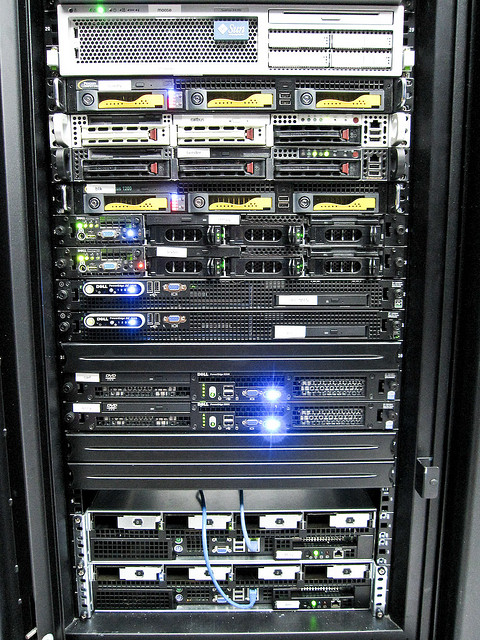
<p>A server is a combination of software and hardware that responds to requests over a network.</p>
<p>A system dedicated to this purpose is often known as &#8220;the server,&#8221;</p>
<p>although systems often provide more than one type of network service.</p>
<p style="text-align: center;"><img class="aligncenter" title="Servers" alt="Server" src="http://farm4.staticflickr.com/3251/2939259129_213eab64b5_z.jpg?zz=1" width="240" height="320" /></p>
<p>Servers have been in use since the mid-1960s,</p>
<p>but their uses have expanded significantly with the development of networks.</p>
<p>Servers now play many different roles within network computing.</p>
<h2><strong>Models</strong></h2>
<p>System designers primarily implement servers with two types of architecture,</p>
<p>including the client-server model and the peer-to-peer model.</p>
<p>A server in the client-server model fulfills requests from other systems known as clients.</p>
<p>They usually connect to the server through the network, although clients may run on the same computer as the client.</p>
<p>The peer-to-peer model involves each system acting as a server or client as needed.</p>
<p>The client-server model is currently more common than the peer-to-peer model.</p>
<h2><strong>Origins</strong></h2>
<p>Servers in the 1960s were large machines that had to be monitored by specialized personnel known as operators.</p>
<p>Local Area Networks began to proliferate during this period, resulting in a greater need for dedicated servers.</p>
<p>Computers became smaller and easier to use, allowing them to be operated by end users by the 1980s.</p>
<p>The Internet began entering mainstream use by this time, causing the media industry to use servers for their distribution services.</p>
<h2><strong>Advancements</strong></h2>
<p>Businesses started using personal computers by the early 1990s to perform services that previously required mainframes.</p>
<p>Early examples of these servers include file servers with CD-ROM drives used to host databases.</p>
<p>The use of dedicated hardware and software to provide network services increased during the 1990s and 2000s.</p>
<p>This type of device is known as a server appliance, which includes gateways, routers and switches.</p>
<p>Examples of self-contained server appliances include the Cobalt Qube, the Google Search Appliance and the RaQ.</p>
<p>Modern operating systems are generally designed to run a variety of software, such that only low-level programs interact with hardware without an application programming interface.</p>
<p>Therefore, system designers often consider an OS to provide hardware to the software.</p>
<p>An OS generally has the ability to run services in the background, so PCs typically run large numbers of client and server applications simultaneously.</p>
<p>The most rapid development in servers has occurred during the last five years.</p>
<p>Many dedicated servers are now standard PCs that are loaded with specialized server software.</p>
<p>However, servers that provide heavy-duty networking services may still be computers specifically designed as servers.</p>
<h2><strong>Uses</strong></h2>
<p>The most common types of servers in a typical network environment include the following:</p>
<ul>
<li><strong>Application server</strong></li>
</ul>
<ul>
<li><strong>Database server</strong></li>
</ul>
<ul>
<li><strong>File server</strong></li>
</ul>
<ul>
<li><strong>Game server</strong></li>
</ul>
<ul>
<li><strong>Mail server</strong></li>
</ul>
<ul>
<li><strong>Print server</strong></li>
</ul>
<p>An application server runs a particular or suite of applications and makes it available to its clients.</p>
<p>A database server hosts a database and makes those services available to other computers or programs.</p>
<p>A file server allows other computers to remotely access files that reside on the server.</p>
<p>A game server typically hosts a network game and allows multiple players to interact with each other within the game.</p>
<p>A mail server receives e-mail for an entire organization and then forwards the mail to the individual recipients.</p>
<p>A print server allows clients to send print requests to one or more printers.</p>
<p>Server types that are less well-known include a catalog server, which provides a central point of access for information search is over a distributed network.</p>
<p>A compute server provides computational capability for users who need to perform intensive calculations, especially in scientific fields.</p>
<p>A proxy server is an intermediate server that process is service requests and towards those requests to another server.</p>
<p>A sound server provides multimedia broadcasting and streaming services for its clients.</p>
<h5>Featured images:</h5>
<p><span class="license">License: Creative Commons</span></p>
<p><span class="source">image source</span></p>
<p>Matt Smith is a Dell employee who writes to help raise awareness on the topic of servers and other network management subjects.</p>

The Changing Role Of Servers