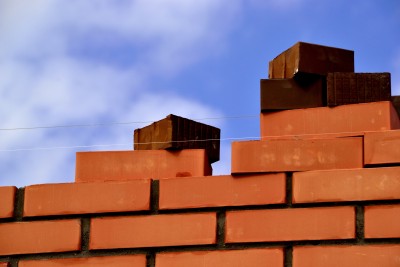
<p>Building walls isn&#8217;t simply a matter of arranging bricks in straight lines. You may have to include corners and, when you come to the end of the wall, it must be finished off properly. The techniques for doing this effectively are relatively easy once you know the basis of brick bonding.</p>
<p>Brick bonds are crucial to bricklaying; simply stacking bricks one above the other without any kind of interlocking would neither distribute the weight of the wall evenly nor provide the wall with any kind of strength, however strong the mortar between the bricks. And because the joints line up they would provide a perfect channel for water to get in and wash out the mortar.</p>
<p>The simplest way of bonding is to overlap the bricks, with no vertical joints continuing through adjacent courses. This kind of bonding can create numerous different patterns ¡ª some very simple, such as the stretcher bond others much more complicated and requiring advance planning.</p>
<p>Exactly the same principle applies whether you&#8217;re building a wall a half-brick thick (a single line of bricks) or one that needs to be one brick thick (two adjacent lines of bricks or one line laid header on). The difference is that instead of only overlapping the bricks length ways as in a stretcher bond you can also overlap them width ways With the header bond, for instance, all of the bricks are arranged header on to the face of the wall ¡ª and again the vertical joints only line up in alternate courses. In effect, the bricks overlap by half their width.</p>
<p>With any bonding pattern, there may be a need for cut bricks to maintain the bond. This may happen at the end of a wall built in stretcher bond where half bricks (called 1/2 bats) are needed in alternate courses. It may also occur where a new wall is being tied in to an existing wall.</p>
<p>Similarly, with a wall built in header bond the ends need two three-quarter bricks (called 3/4 bats) laid side by side in alternate courses to maintain the symmetry, the overlap and wall thickness. With other types of bond, the number and variety of cut bricks increases. The English bond, for instance, alternates a course of bricks laid stretcher face on with a course header face on to make a one-brick thick wall ¡ª and it needs a brick cut in half lengthways (called a queen closer) in each header course or two 3/4 bats laid side by side in the stretcher course.</p>
<p><strong>Corners in brickwork</strong><br />
When it comes to turning a corner in brickwork (known as a quoin) the importance of correct bonding is even more apparent. Without it, you&#8217;d be building two walls which weren&#8217;t interlocked and so lacking in real strength. In a half-brick thick wall in stretcher bond the corner is easy to make. Instead of cutting 1/2 bats for alternate courses, a whole brick is placed header face on at right angles to the front face of the wall.</p>
<p>The necessary &#8216;tying in&#8217; of bricks with other bonding patterns, however, usually requires additional cut bricks and careful planning. In effect, the bond may change when you turn a corner. In header bond for example, which has alternate courses starting with 3/4 bats, 3/4 bats must be placed header on as well to create the corner. In English bond the stretcher course on one side of the quoin becomes the header course on the other.</p>
<p>A bond may also have to be altered if the bricks don&#8217;t fit the actual length of the wall. When this happens you have to break the bond as close as possible to the centre of the wall. If the length differs by 56mm or less don&#8217;t use a 1/4 bat (this is considered bad building practice) but use 1/2 and 3/4 bats instead, making sure you place them so that no straight joints occur.</p>
<blockquote><p><em>Crystal has written this article for Conlin Premier Construction, a peterborough home builder company offering services since last 30 years.</em></p></blockquote>

How to Make Brick Wall Turn a Corner