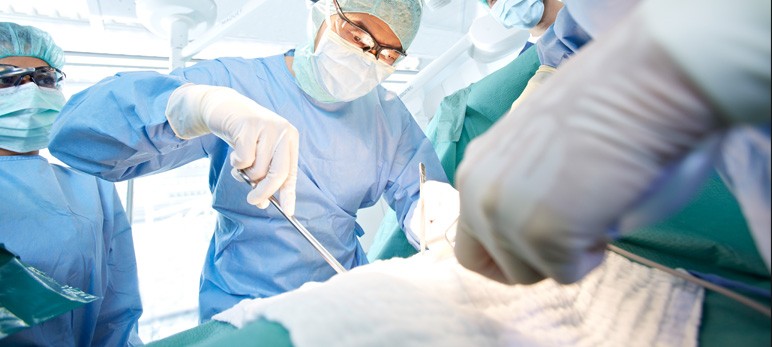
<p style="text-align: justify"><span style="font-weight: 400">Laparoscopic surgery, or minimally invasive surgery, is a specialized technique used to perform surgery. It is a diagnostic process in which the surgeon uses a thin device with an attached light and camera which helps them visualize organ damage and disease more clearly. Even though it was used only for gynecologic and gall bladder surgery in the past, it is now used for intestinal surgery as well. </span></p>
<p style="text-align: justify"><span style="font-weight: 400">One way in which it is different from the traditional ‘open’ surgery is that it uses several incisions each 0.5-1cm wide. These incisions are known as ports, and it is through these ports that a tubular instrument, known as trochar, is inserted. Once this is done, specialized instruments, including a special camera called a laparoscope, is passed through the trochars. </span></p>
<p style="text-align: justify"><span style="font-weight: 400">In the beginning of the surgery, the abdomen is inflated with carbon dioxide so that the surgeon has access to a good working and viewing space. Then, the laparoscope transmits images from the abdominal cavity to the monitor. This allows the surgeon to watch detailed and minute images of the abdomen on the monitor. This also results in performing the same surgery, but with minimal and smaller incisions. </span></p>
<h2 style="text-align: justify"><b>Purpose</b></h2>
<p style="text-align: justify"><span style="font-weight: 400">There are many reasons for conducting a laparoscopy. Some of the common reasons are:</span></p>
<ol style="text-align: justify">
<li style="font-weight: 400"><span style="font-weight: 400">For the diagnosis and treatment of endometriosis, chronic pelvic pain, pelvic inflammatory disease, pelvic infection, and to recognize the causes of infertility.</span></li>
<li style="font-weight: 400"><span style="font-weight: 400">For the removal of fibroids, uterus, ovarian cysts, lymph nodes, or an ectopic pregnancy.</span></li>
<li style="font-weight: 400"><span style="font-weight: 400">For the treatment of many disorders like urinary incontinence, pelvic organ prolapse, and some types of cancer.</span></li>
<li style="font-weight: 400"><span style="font-weight: 400">For the evaluation of some cancers, including that of ovary, uterus and cervix.</span></li>
</ol>
<h2 style="text-align: justify"><b>Advantages</b></h2>
<p style="text-align: justify"><span style="font-weight: 400">One major advantage of this surgery is that the patients experience less pain. The recovery time is also shorter and there is less scarring as compared to traditional open surgery. </span></p>
<h2 style="text-align: justify"><b>Safety</b></h2>
<p style="text-align: justify"><span style="font-weight: 400">The safety involved in laparoscopic surgery is the same as in traditional open surgery. However, like any other surgery, this procedure also has its own risks. These include complications related to anesthesia and bleeding or infections. The probability of risks also depends on an individual’s general health along with his/her other medical conditions. Some risks include:</span></p>
<ol style="text-align: justify">
<li style="font-weight: 400"><span style="font-weight: 400">Bleeding, which can lead to the need of blood transfusion</span></li>
<li style="font-weight: 400"><span style="font-weight: 400">Infection</span></li>
<li style="font-weight: 400"><span style="font-weight: 400">Hernia </span></li>
<li style="font-weight: 400"><span style="font-weight: 400">Damage to internal structures, including blood vessels, stomach, bowel, bladder, ureter, etc.</span></li>
<li style="font-weight: 400"><span style="font-weight: 400">Reactions to anesthesia </span></li>
<li style="font-weight: 400"><span style="font-weight: 400">Abdominal inflammation or infection</span></li>
<li style="font-weight: 400"><span style="font-weight: 400">Blood clots </span></li>
</ol>
<p style="text-align: justify"><span style="font-weight: 400">To reduce risks, it is important to go to a hospital, which offers the best facilities for </span><span style="font-weight: 400">laparoscopic surgery in India</span><span style="font-weight: 400">, the likes of Fortis La Femme. </span></p>
<h2 style="text-align: justify"><b>Recovery period</b></h2>
<p style="text-align: justify"><span style="font-weight: 400">During the recovery period, there are certain problems that a person can experience. These include:</span></p>
<ol style="text-align: justify">
<li style="font-weight: 400"><span style="font-weight: 400">Fatigue</span></li>
<li style="font-weight: 400"><span style="font-weight: 400">Sore throat-this is because of the breathing tube that is used during the surgery</span></li>
<li style="font-weight: 400"><span style="font-weight: 400">Discomfort at the site of the incisions that are made during the procedure</span></li>
<li style="font-weight: 400"><span style="font-weight: 400">One may experience shoulder or back pain because of any remaining carbon dioxide in the abdomen that can irritate the diaphragm</span></li>
</ol>
<p style="text-align: justify"><span style="font-weight: 400">However, if you experience worsening of the pain, nausea or vomiting, heavy vaginal bleeding, fainting, signs of infections, inability to empty the urinary bladder, or shortness of breath, it is advisable to consult your doctor and discuss these problems. If the above mentioned symptoms persist for more than a few days, an appointment with your physician is a must. It is always a good idea to be in touch with your doctor to avoid any complications or unnecessary problems. </span></p>
<p style="text-align: justify"><span style="font-weight: 400"></p>
<p></span></p>

Everything There is to Know About Laparoscopic Surgery