<p style="text-align: justify;">Fireplaces serve very well as the central gathering place for family life. On a cold evening, it’s a very tribal experience to gather around the fireplace to relax, read and maybe watch TV. But for those concerned about the environmental impact of fireplaces, there are certainly a number of factorsto consider as well.</p>
<p style="text-align: justify;">Here are 6 of the most popular environmentally friendly fireplace optionsin the marketplace today:</p>
<p style="text-align: center;"><img class="aligncenter size-full wp-image-7234" title="6 Environmentally Friendly Fireplace Options To Consider" alt="6 Environmentally Friendly Fireplace Options To Consider" src="https://medusamagazine.com/wp-content/uploads/2013/09/fireplace1.jpg" width="440" height="440" /></p>
<h3 style="text-align: justify;"><strong>Electric Fireplaces</strong></h3>
<p style="text-align: justify;">Electric fireplaces are very affordable, inexpensive to run and vastly improved from earlier versions. Additionally, they’re very easy to install, clean to use, produce no emissions and require no chimney or venting compared to traditional fireplaces. Electric fireplace products can either be built into the existing hearth or bought as self-contained units and placed anywhere in the room where there’s an electric socket.</p>
<p style="text-align: justify;">Most electric fireplaces come with their own thermostat, so it’s up to you to regulate the temperature as you see fit. They can also be used without the heating element for the simple beauty of the flame, allowing you to make use of them all year round. All in all, one of the more popular, effective and environmentally friendlyfireplace options to consider.</p>
<h3 style="text-align: justify;"><strong>Bio-Ethanol Fireplaces</strong></h3>
<p style="text-align: justify;">Bio-ethanol fireplaces are making headlines as some of the most environmentally friendly fireplaces in the marketplace. They’re being used in lots of new home constructionlargely because of their stylish and eco-friendly nature. These fireplaces use ethyl alcohol, a bio fuel that’s clean and easy to use. (Bio-ethanol fuel is produced by the fermentation of sugar in agricultural crops.)But if you live in a large home and/or a cold area, you might reconsider this option because bio-fuel fireplaces generally don’t provide much heat.</p>
<p style="text-align: justify;">The good news is that the fire insert, which is the portion of the unit used for the bio-ethanol burning,is smokeless, leaves no soot or ash to clean up and requires no venting.</p>
<h3 style="text-align: justify;"><strong>Wood Burning Stoves&; Inserts</strong></h3>
<p style="text-align: justify;">Wood burning stoves have made a steady come back in recent years. Many people love the idea of a wood burning stove in their homes, especially in a rural setting. Unlike bi-ethanol fireplaces, wood burning stoves are capable of heating the entire house.</p>
<p style="text-align: justify;">While the unit itself can be very expensive, wood burning stoves are generally inexpensive to operate with the average cost of a cord of wood in the U.S. running about $190.</p>
<p style="text-align: justify;">Burning firewood is not as harmful to the environment as most people seem to think either. According to a report by the Hearth, Patio &; Barbecue Association (HPBA), the same carbon gases are given off when a tree decomposes compared to when you burn firewood so there is actually zero net carbon being released into the environment.</p>
<p style="text-align: justify;">On the downside, however, you have to clean and empty the ashes from the firebox regularly. Most homes also don’t have thermostats in every roomso the rooms adjacent to where the stove resides typically become colder than the heated space, which might prompt you to raise the thermostat in the colder roomsand defeat the potential energy savings of the stove entirely.</p>
<h3 style="text-align: justify;"><strong>Pellet Stoves</strong></h3>
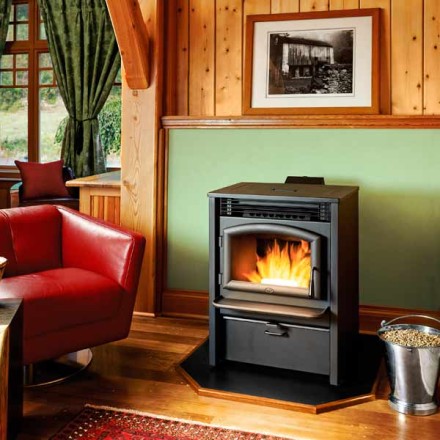
<p style="text-align: justify;">Pellet stoves are great for heating large spaces as well. They’re clean and environmentally friendly and suitable for most homes. Roughly 800,000 homeowners are now using them in the U.S. alone.</p>
<p style="text-align: justify;">Wood pellet fuel is made from a combination of agricultural waste like bark, sawdust and wood shavings. Wood pellets are roughly 3/8 of an inch to an inch in size, are denser than wood and burn cleaner with less smoke and ash emissions. Turning wood waste into an efficient fuel source results in far less waste being dumped into landfills.</p>
<p style="text-align: justify;">Additionally, pelletized wood produces very little air pollution, has much higher combustion and heating efficiencies than ordinary wood burning and is far more environmentally friendly when compared to non-renewable fossil fuels such as natural gas, oil, and coal.While you can use pellets to run a whole-house heating system, pellet stoves aretypically used to supplement other heating sources in the home.</p>
<p style="text-align: justify;">One particular downside to wood-burning and pellet-burning units is that they require constant attention—lighting, feeding, tending, and cleaning—especially when compared to the &#8220;Start Here&#8221; ease of most gas-, electric-and oil-powered appliances.</p>
<h4 style="text-align: justify;"><strong>Gas Logs: </strong></h4>
<p style="text-align: justify;">Gas logs are built for burning either natural gas or liquid propane (LP) and can be retrofitted in an existing fireplace as an alternative to wood. So, while gas logs do indeed burn fossil fuels, according to the EPA on its Burn Wise website, they still have low emissions.Liquid propane is supplied from a tank that sits outside the home while natural gas is piped directly in from the outside. In terms of cost, liquid propane is more expensive and also contains more carbon than natural gas but burns more than three times hotter.</p>
<p style="text-align: justify;">Gas logs can be purchased as either vented or vent-free. Vented logs simulate a wood-burning flame most closely but do require operation with an open chimney flue or damper. Vent-free logs won’t provide that roaring fire effect but will provide ample heat for smaller areas and typically contain a thermostat as well to maintain a steady room temperature.</p>
<h3 style="text-align: justify;"><strong>Gas Stoves</strong></h3>
<p style="text-align: justify;">Gas stoves are also very convenient options comparable to a wood burning stove or fireplace. Similar to gas logs, these stoves are built to burn either natural gas, or liquid propane. Gas stoves are freestanding units, however, while gas logs are built forpre-existing fireplaces.Although they still burn fossil fuels, they produce lower emissions than wood or other alternatives.</p>
<p style="text-align: justify;">While you won’t get the snap, crackle, pop of a traditional wood fire or the ceremony that goes along with it, bringing in the firewood from outdoors and starting the kindling, what you will get, however, is greater efficiency and convenience. They can be installed almost anywhere in the home quite easily, as they can be vented through the wall behind the stove or from your existing chimney if you wish. They’re popular eco-friendly options because theyemit very little pollution and require minimal, if any, upkeep.</p>
<p style="text-align: justify;">(It’s important to note, however, that the EPA does not support vent-free models because of “indoor air quality” concerns particularly for people suffering from respiratory diseases, such as asthma.)</p>
<h3 style="text-align: justify;"><strong>Making Your Choice</strong></h3>
<p style="text-align: justify;">Electric fireplaces are convenient, easy to install, simple to use and very cost effective. Bio-ethanol fireplaces are stylish and also easy to use but won’t provide sufficient heat for larger spaces and homes. Both pellet and wood-burning stoves, on the other hand, provide amplesources of heat for most homes but require maintenance and constant cleaning. Gas logs are another affordable, eco-friendly and efficient optionto consider as well for smaller areas and rooms within the home. Gas stoves also emit very little pollution, require minimal upkeep, are convenient and easy to use but will also provide more heat than gas logs.</p>
<p style="text-align: justify;">When considering environmentally friendly fireplace options, make sure that you take the time to consider all factors before you make a purchasing decision, not only the environmental factors. The amount of heat provided, convenience, ease of installation and cost are important factors that should also be considered alongside environmental considerations.</p>
<p style="text-align: justify;">Have you had any experience with any of these eco-fireplace options mentioned above?</p>
<p style="text-align: justify;"><i>AnnePetry is a DIY home improvement expert and eco-friendly minded blogger at </i><i>ElectricFireplacesCanada.ca</i><a name="141306beb813130c__GoBack"></a><i>.</i></p>

6 Environmentally Friendly Fireplace Options To Consider